Research Interest
Overview
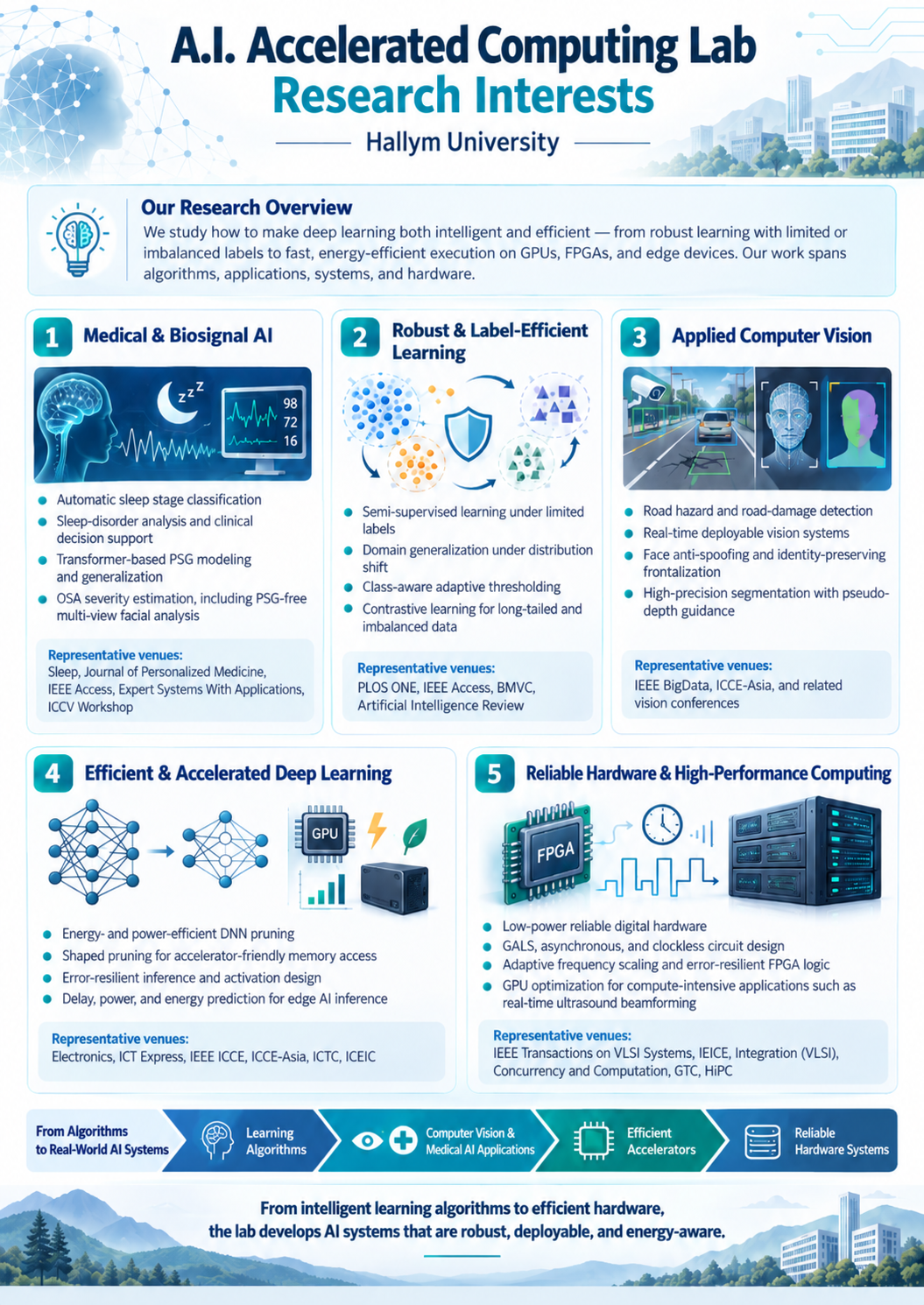
The A.I. Accelerated Computing Lab at Hallym University studies how to make deep learning both intelligent and efficient — from learning algorithms that stay robust with limited or imbalanced labels, to the hardware and systems that run them quickly and at low energy on GPUs, FPGAs, and edge devices.
Our work spans the full stack: medical and biosignal AI, robust and label-efficient learning, applied computer vision, energy-aware model compression and accelerator design, and low-power reliable digital hardware. The directions below summarize our main themes, each grounded in the lab’s publications.
국문 요약
한림대학교 A.I. Accelerated Computing Lab은 딥러닝을 ‘똑똑하면서도 효율적으로’ 만드는 방법을 연구합니다. 제한적이거나 불균형한 레이블에서도 견고하게 학습하는 알고리즘부터, 이를 GPU·FPGA·엣지 디바이스에서 빠르고 적은 전력으로 구동하는 하드웨어·시스템까지 다룹니다.
연구는 의료·생체신호 AI, 견고하고 레이블 효율적인 학습, 응용 컴퓨터 비전, 에너지 인지형 모델 경량화 및 가속기 설계, 저전력·고신뢰 디지털 하드웨어에 이르는 전 영역을 아우릅니다. 아래 주제들은 연구실의 논문을 근거로 정리한 주요 방향입니다.
Medical & Biosignal AI
A central and long-running line of our research applies deep learning to clinical decision support, with a particular focus on automatic sleep stage classification and sleep-disorder analysis.
We have constructed standardized image-based polysomnography (PSG) databases and multi-institutional deep learning pipelines for sleep staging, analyzed Transformer attention behavior to improve generalization, and developed models for obstructive sleep apnea (OSA) severity — including recent PSG-free approaches that estimate severity from multi-view facial imaging.
Representative venues: Sleep; Journal of Personalized Medicine; IEEE Access; Expert Systems With Applications; ICCV Workshop on Computer Vision for Automated Medical Diagnosis.
국문 요약
우리 연구의 핵심 축은 딥러닝을 임상 의사결정 지원에 적용하는 것으로, 특히 자동 수면 단계 분류와 수면장애 분석에 오랫동안 집중해 왔습니다.
표준화된 이미지 기반 수면다원검사(PSG) 데이터베이스와 다기관 딥러닝 파이프라인을 구축하고, 일반화 성능 향상을 위해 Transformer의 어텐션 동작을 분석했으며, 폐쇄성 수면무호흡증(OSA) 중증도 예측 모델 — 최근에는 다시점 얼굴 영상만으로 중증도를 추정하는 PSG-free 방식 — 을 개발했습니다.
주요 발표처: Sleep, Journal of Personalized Medicine, IEEE Access, Expert Systems With Applications, ICCV Workshop(의료영상 자동진단).
Robust & Label-Efficient Learning
Real-world data is imbalanced, weakly labeled, and drawn from shifting distributions. We develop semi-supervised and domain-generalization methods that remain accurate under these conditions.
Recent work includes class-aware adaptive thresholding for semi-supervised domain generalization, separated and independent contrastive learning for long-tailed and imbalanced datasets, and a survey of domain generalization for semantic segmentation.
Representative venues: PLOS ONE; IEEE Access; British Machine Vision Conference (BMVC); Artificial Intelligence Review.
국문 요약
실제 데이터는 불균형하고, 레이블이 부족하며, 분포가 계속 변합니다. 우리는 이런 조건에서도 정확도를 유지하는 준지도학습·도메인 일반화 기법을 개발합니다.
최근 연구로는 준지도 도메인 일반화를 위한 클래스 인지 적응형 임계값(class-aware adaptive thresholding), 롱테일·불균형 데이터를 위한 분리·독립 대조학습, 그리고 시맨틱 세그멘테이션 도메인 일반화 서베이가 있습니다.
주요 발표처: PLOS ONE, IEEE Access, BMVC, Artificial Intelligence Review.
Applied Computer Vision
We turn these learning methods into deployable vision systems for real applications:
Road hazard & damage detection — real-time inference frameworks and standardized labeling protocols, recognized at the Optimized Road Damage Detection Challenge (IEEE BigData, ICCE-Asia).
Face analysis — presentation-attack (anti-spoofing) detection with deformable convolutions, and identity-preserving face frontalization (PoseDefCycleGAN).
Segmentation — high-precision multi-decoder segmentation using pseudo depth maps and efficient training strategies.
국문 요약
이러한 학습 기법을 실제 응용을 위한 비전 시스템으로 구현합니다:
도로 위험·손상 탐지 — 실시간 추론 프레임워크와 표준 라벨링 프로토콜. 도로 손상 탐지 챌린지에서 우수 성과(IEEE BigData, ICCE-Asia).
얼굴 분석 — 디포머블 컨볼루션 기반 얼굴 표현 공격(안티스푸핑) 검출, 신원 보존 얼굴 정면화(PoseDefCycleGAN).
세그멘테이션 — 의사 깊이맵(pseudo depth map)과 효율적 학습 전략을 활용한 고정밀 다중 디코더 분할.
Efficient & Accelerated Deep Learning
Reflecting the lab’s name, we make neural networks fast and energy-efficient on real hardware — GPUs, FPGAs, and edge accelerators.
Our methods include filter and zero-keep pruning for energy- and power-efficient DNNs, shaped pruning for efficient memory addressing in accelerators, error-resilient inference with error-aware activation functions, and regression-based prediction of the delay, power, and energy of edge AI inference.
Representative venues: Electronics; ICT Express; IEEE ICCE and ICCE-Asia; ICTC; ICEIC.
국문 요약
연구실 이름에 걸맞게, 신경망을 실제 하드웨어(GPU·FPGA·엣지 가속기)에서 빠르고 에너지 효율적으로 동작시키는 방법을 연구합니다.
에너지·전력 효율적 DNN을 위한 필터/zero-keep 프루닝, 가속기의 효율적 메모리 접근을 위한 shaped pruning, 오류 인지 활성화 함수를 이용한 오류 견딤(error-resilient) 추론, 엣지 AI 추론의 지연·전력·에너지 회귀 예측 등이 포함됩니다.
주요 발표처: Electronics, ICT Express, IEEE ICCE·ICCE-Asia, ICTC, ICEIC.
Reliable Hardware & High-Performance Computing
The lab’s systems foundation is low-power, reliable digital design together with high-performance computing.
On the hardware side, we study globally-asynchronous locally-synchronous (GALS) and multi-frequency clocking for EMI and switching-noise reduction, asynchronous and clockless circuits for low-voltage energy efficiency, adaptive frequency scaling with in-situ timing detectors, approximate multipliers for error-tolerant applications, and error-resilient flip-flops and self-checking logic on FPGAs.
On the computing side, we optimize compute-intensive GPU workloads — notably real-time software ultrasound beamforming and B-mode imaging — analyzing how optimization strategies and voltage/frequency scaling affect performance, power, and energy.
Representative venues: IEEE Transactions on VLSI Systems; IEICE Transactions / Electronics Express; Journal of Circuits, Systems and Computers; Integration, the VLSI Journal; Concurrency and Computation; GTC; HiPC.
국문 요약
연구실의 시스템적 토대는 저전력·고신뢰 디지털 설계와 고성능 컴퓨팅입니다.
하드웨어 측면에서는 EMI·스위칭 노이즈 저감을 위한 GALS 및 다중 주파수 클로킹, 저전압 에너지 효율을 위한 비동기·클록리스 회로, in-situ 타이밍 검출기 기반 적응형 주파수 스케일링, 오류 허용 응용을 위한 근사 곱셈기, FPGA상의 오류 견딤 플립플롭·자기검사 로직을 연구합니다.
컴퓨팅 측면에서는 연산 집약적 GPU 워크로드 — 특히 실시간 소프트웨어 초음파 빔포밍과 B-모드 영상 — 를 최적화하며, 최적화 전략과 전압/주파수 스케일링이 성능·전력·에너지에 미치는 영향을 분석합니다.
주요 발표처: IEEE TVLSI, IEICE, Journal of Circuits, Systems and Computers, Integration(VLSI), Concurrency and Computation, GTC, HiPC.